By Kathleen Berger, Executive Producer for Science and Technology
St. Louis critters, both large and small, are caught on camera!
“Recently we got one with a coyote and a possum. We don’t know what happened from that interaction. But it’s cool to also realize that we see these different animals all using these same sites and occasionally we happen to get an interesting shot of some wildlife interaction,” said Whitney Anthonysamy, associate professor of biology at University Health Sciences and Pharmacy in St. Louis (UHSP) and co-principal investigator of the St. Louis Wildlife Project.
Since the project began in 2018, the approximate 336,000 images of animals from 41 locations in the St. Louis area offer valuable information. The numbers are growing as the project is ongoing. The 41 locations have motion-activated camera traps.
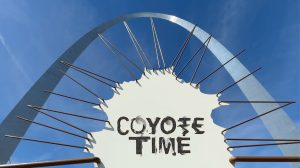
“At mostly parks and natural areas,” explained Anthonysamy. “And we have them spaced along a natural urbanization gradient, starting at the St. Louis Arch out to Eureka, Missouri.”
Anthonysamy’s undergraduate biology students at UHSP have a role with the research, taking on the photo tagging process.
“It’s a really great opportunity to get students involved in research. It takes a long time to process the thousands of images we get,” said Anthonysamy. “Ultimately, that’s the data that we use to answer our research questions.”
One question relates to the gentrification of cities.
“Gentrification is this process where affluent residents displace under-resourced, underserved, marginalized residents.”
The St. Louis Wildlife Project’s data collection, led by Anthonysamy and researchers at Washington University in St. Louis, contributed to a national study to understand gentrification and what happens with mammals in gentrified areas. The St. Louis Wildlife Project is a partner city in The Urban Wildlife Information Network, based at the Lincoln Park Zoo in Chicago. The data collected in St. Louis goes into an international database.
In a study led by Lincoln Park Zoo’s Urban Wildlife Institute, data from 23 cities in the U.S., including St. Louis, proved how gentrified parts of a city have notably more urban wildlife than ungentrified parts of the same city.
“What tends to happen then, is you have an increase in the quality of the green spaces and green infrastructure in these gentrified areas,” said Anthonysamy. “Gentrified areas did have more mammal diversity. On average, these gentrified areas would have an additional one or two species than ungentrified areas.”
The research is about the understanding of urban ecology and biodiversity. The findings are beneficial to wildlife management and the support of sustainable urban planning. Anthonysamy said St. Louis plays an important role in maintaining biodiversity.
“One of the great things about St. Louis is that we have a lot of amazing green spaces, and so we have a lot of opportunities to interact with nature and interact with wildlife,” she said. “The more rare (images) are bobcats, armadillos. Occasionally, we’ll get a flying squirrel.
Among the more common animals are deer. And deer carry ticks with diseases that are spread to people. Now, with grant support from UHSP, the St. Louis Wildlife Project is expanding the research focus to include testing for diseases in ticks collected from the project’s research sites.
“The ‘tick project’ is related to the camera trapping work, but it’s kind of a pilot. We’re trying to generate some preliminary information to do a more expansive project.”
While the tick research is just beginning, the photo tagging of thousands of camera shots continues. And there are some animals the researchers and students hope to catch on camera.
“We haven’t gotten any bears yet, and we haven’t gotten any mountain lions either. We’re hoping that we do one of these days,” said Anthonysamy.