In the days before most homes had a washing machine and dryer, the family’s laundry was done by washerwomen who traveled through neighborhoods gathering dirty clothes, taking them to a central location where they washed them in boiling water with soap and starch they compounded, ironed them, folded them, and carried them back to the families. These were largely Black women, former slaves, with some whites and indigenous women as well. Their hours were long and the pay small, sometimes only a dollar a week when there was pay, sometimes just beans and rice traded for the washing, if even that.
In the summer of 1881, twenty African American women in Atlanta organized The Washing Society, determined to change things, increase their pay, improve their working conditions, and gain respect. They successfully recruited other laundresses, including whites and indigenous women, and grew large and confident enough to declare a strike. In three weeks, The Washing Society had 3,000 members on strike.
The white establishment and its newspaper, the Atlanta Constitution, assured their community that the strike would fail when white investors opened a large Steam Laundry with “smart Yankee girls” as the employees. These city fathers resorted to fines and special taxes and even arrested the Society’s leaders for “disorderly conduct.”
But all that dirty laundry piling up created a pall over the city. And with the International Cotton Exposition, a sort of World’s Fair, due soon to open in Atlanta and bringing visitors from all over the world, the white establishment was eager to present the city at its best. When the Society’s leaders offered to meet with the mayor and present their demands, he quickly agreed, and agreed to meet their demands.
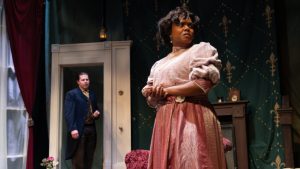
That is what The Black Rep’s current production, The Wash, by Kelundra Smith, is about. It is a very satisfying, little-known story, and it is a very satisfying production. Velma Austin is a natural leader as Anna, in whose home the laundry functions and the Society meets, with Anna often the spokesperson for the group. The other actors, equally fine, are Paulette Dawn, Christina Yancy, Joy Ike, Alex Jay, and Jennifer Theby-Quinn as a white woman who joins them.
Chris Anthony’s direction fills the staging with the women’s energy, with the cast regularly breaking into rhythmic singing and Heather Beal’s choreography as scene breaks. Dunsi Dai’s scene design uses wooden chairs and work tables, laundry baskets and washtubs backed with large white sheets drying on upstage clothes lines that serve as projection screens for scenery and for quotations from the characters. Jasmine Williams designed lighting, Asha-Ti Nu the sound, Kareem Deans the projections, Lou Bird the costumes, and Mikhail Lynn the props. Tracy Holliway-Wiggins is the Stage Manager, Jordan Jones is her assistant, and Christian Kitchens is the Technical Director.
History is full of stories like The Wash. Thanks to playwright Kelundra Smith and The Black Rep for bringing this one so entertainingly to our attention.
—Bob Wilcox
Photo by Keshon Campbell
From left to right, Joy Ike as Charity and Christina Yancy as Thomasine in The Wash.
Review of <em>The Wash</em> at The Black Rep