By Kathleen Berger, Executive Producer of Science and Technology
St. Louis-based Geneoscopy is helping to prevent deadly colon cancer from developing. Across the country, patients and their doctors are getting an answer without a colonoscopy through Geneoscopy’s colorectal cancer screening tool. It’s noninvasive, only needing stool.
“You poop, you ship it back,” said Co-Founder and Chief Medical & Science Officer Erica Barnell, MD, PhD.
It all started with an idea in medical school.
“Only 10 years ago, we were three students with an idea sitting in the medical school at WashU (Washington University School of Medicine in St. Louis) thinking about how we can help patients with colon cancer,” said Erica Barnell.
“We were students without a lab space, and needed help with a bench and some instruments,” explained Andrew Barnell, Erica’s brother, Co-Founder and CEO of Geneoscopy.
Taking on this challenge, the dynamic sister and brother team created Geneoscopy.
“The premise for the company was to evaluate RNA biomarkers in stool samples,” she said. “We recognized that RNA provided insight into disease and what was happening in real time.”
“Our first-ever lab was in the BioGenerator Accelerator Labs,” said Andrew Barnell.
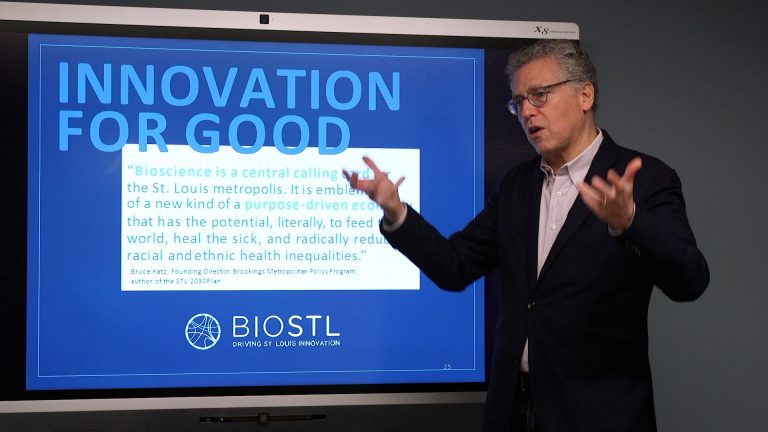
BioGenerator is the startup arm of BioSTL, in St. Louis. Geneoscopy is now located in a growing facility in Maryland Heights, becoming one of BioGenerator’s success stories. The company met a series of major milestones with its colorectal cancer screening test, called ColoSense. In May of 2024, ColoSense became the first FDA-approved RNA-based stool test for colorectal cancer screening in adults ages 45 and older. Additionally, Geneoscopy announced a major collaboration with Labcorp that would help reach millions of patients.
“That test is going to serve as a frontline screening option for 110 million people in the screening population,” said Andrew.
“We have a strategic collaboration with Labcorp. Any patient going to their primary care ordering a CBC or lipid panel, or whatever it is, through Labcorp can order a ColoSense test through that exact same portal,” said Erica. “We get a notification. Then one of our collection kits that’s FDA-approved will ship to that patient’s residence. They deposit a sample. It gets shipped back to our laboratory. And our results go back through that Labcorp portal to provide the healthcare provider more information about what to do next.”
Geneoscopy expects to exceed its current laboratory capacity of processing 250,000 samples a year, so the company is planning to expand.
“It would be shocking to the average person how much joy it brings me to have our freezers just stocked to the brim with samples,” said Erica “But for me, data is power.”
Geneoscopy is advancing the technology to other gastrointestinal diseases starting with IBD, Inflammatory Bowel Disease.
Learn more about Geneoscopy in STL Made’s story, “Screening Startup.”