In most seasons since 2017, Union Avenue Opera’s schedule has included a Broadway musical. The first was “Carousel”; this year’s is “Fiddler on the Roof.” All these productions have one thing in common: unamplified voices.
Microphones were not needed in Broadway theaters until voices had to compete with electronic instruments in rock musicals. Before then, musical theater professionals had the training and the technique required to make themselves heard in a Broadway theater.
Today, microphones are the norm in musicals. Amplification has many benefits, but Union Avenue has proved its audience appreciates unmiked voices in musicals as well as operas. The company’s attendance at recent musicals has been excellent, as it was last Friday for the opening of “Fiddler.”
Hearing Union Avenue’s cast is a treat in the songs by composer Jerry Bock and lyricist Sheldon Harnick. The production’s other strengths outweigh its limitations.
Joseph Stein’s compelling book is based Sholem Aleichem’s short stories about a dairy man named Tevye, who must cope with difficulties and dangers of early 20th century life in a Russian village named Anatevka. One of the difficulties is having five daughters of or nearing marriageable age. One of the dangers is the increasing persecution of the Jews under the Tsar.
The show’s title comes from a painting of a rooftop fiddler by Marc Chagall. The fiddler in the musical is a symbol of the precarious existence led by people in a community held together by traditions that are under threat.
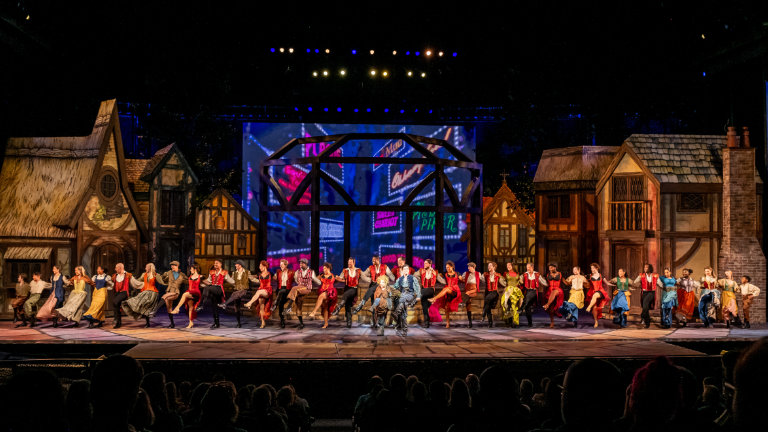
Respect for traditions is essential in a musical about the importance of traditions. Union Avenue shows this respect in the authenticity of Kasey Cox’s direction in action ranging from ordinary to sacred, in the accuracy of the many appealing costumes by Teresa Doggett, and in the way the set compensates for the limited room on the stage.
Patrick Huber’s scenic design starts out as a bare wooden scaffold. During the opening number, the company adorns the scaffold with segments of paintings reminiscent of Chagall’s, if not by Chagall. Set pieces that take up space are kept to a minimum. In a very moving scene, the cast lovingly takes down the pictures as the expelled Jews are leaving their homes behind but taking their traditions with them. The scenic artist is Tobias Reynolds, the lighting designer is Zak Metalsky, and the properties master is Cecile “CeCe” Entz.
The show’s musical elements are predictably strong. Scott Schoonover conducts the fine orchestra in an affectionate and authoritative account of the score. The choral singing is gorgeous.
Heading the cast of excellent singers is E. Scott Levin as Tevye. Levin’s singing is inspiring, and his command of the role produces stirring drama. In order of appearance, the voices worth hearing without microphones in named roles belong to:
- Amy Maude Helfer as Yente, a matchmaker
- Bradley J. Behrmann as Avram, a bookseller
- Cole Gutman as Nachum, a beggar
- Spencer Reichman as Lazar Wolf, a butcher
- Ryan Cooper as Mendel, the Rabbi’s son
- Joel Rogier as Rabbi
- Kate Tombaugh as Golde, his wife
- Brianna Murray as Tzeitel, his daughter
- Vianca Alejandra as Hodel, his daughter
- Arielle Pedersen as Chava, his daughter
- Sophie Azra Yilmaz as Shprintze, his daughter
- Audrey Sondag as Bielke, his daughter
- Eric Botto as Motel, a tailor
- Philip Touchette as Mordcha, an innkeeper
- John Tibbetts as Perchik, a student
- James Stevens as Fyedka, a young Russian
- Trevor Scott as Sasha, a Russian
- Samuel Wright as Constable
- Stephanie Tennill as Grandma Tzeitel
- Gina Malone as Fruma-Sarah, Lazza Wolf’s first wife
- Kay Love as Shaindel, Motel’s mother
- Charles McCall as Yussel
The villagers, Russians, and dancers include Madeline Black, Michael Curdt, Rebecca Hatlelid, Brittany Moleski, John Richey, Bryn Sentnor, and Vanessa Simpson.
The production’s main limitations stem from the location. First, Union Avenue’s stage has limited room for dancing. Do not expect to see the original Jerome Robbins choreography in all its glory. That said, Andrea Reed’s choreography is well suited to the space and features an impressive bottle dance at the wedding. Second, dialogue may not be ideally clear when performers chosen primarily for their singing voices are speaking in Union Avenue’s resonant acoustic. The company addresses this issue by including the spoken lines as well as the lyrics in the supertitles. The supertitle designer is Philip Touchette.
“Fiddler on the Roof” continues through July 11 at the Union Avenue Christian Church, 733 North Union Boulevard. In a smart move, Union Avenue now opens its season with the musical, giving people brought in by the musical two chances to return for the company’s operas. This season continues with:
- Donizetti’s “L’elisir d’amore,” opening July 24
- Saint-Saens’ “Samson et Dalia,” opening August 14
—Gerry Kowarsky
Photo by Dan Donovan Photography
The company of “Fiddler on the Roof” in “To Life.”