A medical term takes its name from Sir Arthur Conan Doyle’s 1902 novel The Hound of the Baskervilles. The Baskerville Effect is a statistical observation noting that fatalities from heart attacks are increased by extreme fear or stress. So it is that a gigantic, ghostly, blood-flecked hound with fiery red eyes roaming the moor at night becomes the murder weapon in Doyle’s story. The legend of the hound of the Baskervilles, the family name of the owners of the mansion and estate on the edge of a moor, goes back to the seventeenth century and a baronet ancestor who chased a young neighbor woman to her death and was himself found dead with his throat ripped open by some terrible beast. His heirs now fear that they too will be made to pay for his sins.
Sir Charles Baskerville is the latest heir to be found dead just outside the gates of the estate with a look of terror on his face and the pawprints of a large hound about his corpse. Now his nephew, Sir Henry Baskerville, is coming to take his place as the heir of Baskerville Hall. And the hound waits.
In Doyle’s story, Sir Henry grew up in Canada, where his father, a Baskerville younger son, went to make his fortune, which he did. In Ken Ludwig’s version he grew up in Texas, with a Texan accent and ten-gallon hat, which makes him more fun for an American audience. The local doctor in the Baskerville village, Dr. James Mortimer, was a friend of the late Sir Charles. He also during his residency at a hospital in London became acquainted with Dr. Watson and through him with Sherlock Holmes. Worried about the safety of the nephew of his Baskerville friend, Dr. Mortimer asks Holmes to look into the matter, which he does, with considerable help from Watson, who also breaks the fourth wall to introduce the play and occasionally to keep us in the audience informed about what was happening.
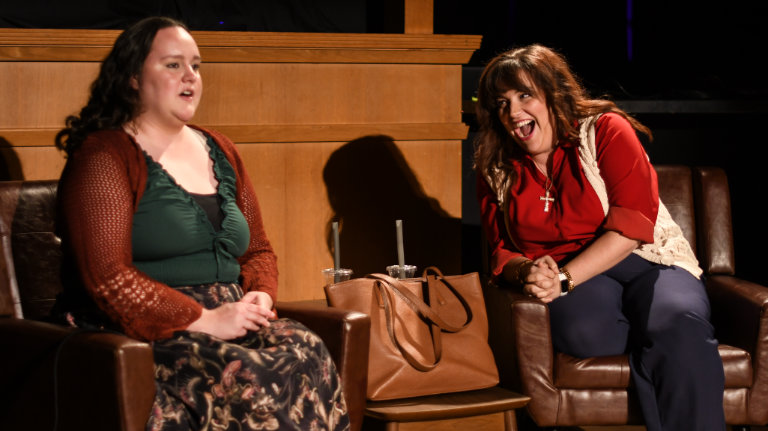
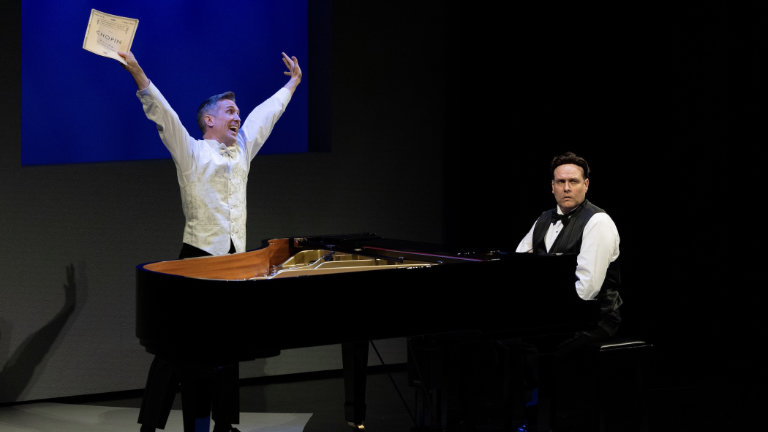
Playwright Ken Ludwig made his reputation with one of the best farces in the American theatre, Lend Me a Tenor, and with the revised book for the Gershwins’ 1930 musical Girl Crazy, now called Crazy for You. Ludwig kept pretty much all of Doyle’s story, including suspense, mystery, and red herrings. Some laughs are in the lines, but most of the fun comes from watching three actors play almost forty characters, with quick changes in dress and speech. Usually they stepped off stage to make the changes, but near the end, when we were thoroughly acquainted with what was going on, one of them just remained on stage down left to remove a beard and a wig and some clothes and replace them, and one actor played two characters in conversation with each other, changing hats to help us follow who was who. Nick Freed is a tall, slender, and thoroughly confident Holmes. Bryce A. Miller gave Dr. Watson the assurance needed for his active role. Alice Revé Like, Sean C. Seifert, and John Wilson took on the other forty-some roles with precise definition and impressive timing and presence. I especially was pleased to see Like, whose musical writing and performance I have often admired, with major acting done as I have suspected she could do.
Nisi Sturgis directed inventively and with clarity. Seiko Huffman’s scenery moved smartly to make places easily identified. Michelle Friedman Siler designed costumes with wit and ease of change, assisted by Elena Jaquez. Katherine Stepanek’s lighting adds mystery when needed. Victoria Deiorio’s original music and sound design enrich the scenes. Ethan Foss handles sound recreation. Monica Dickhens is the Stage Manager and Gregory Carr II is her assistant. Dialect Coach Lauren Roth prepared the actors well. Zev Steinrock was the Intimacy and Fight Coordinator.
Abby Pastorello designed wigs and supervises the wardrobe. Katie Orr supervises props. Cameron Tesson was the Paint Charge, Tony Anselmo is the Electrics Supervisor, Addie McGrath is the Board Operator, Sophia Urban is the Assistant to the Director and Stagehand, Jack Kalan is the Electrician, Kim Carlson is the Stitcher, and Shevare Perry designed Miss Stapleton’s wig. Rebecca Scallet is the Artistic Director of the New Jewish Theater, Laura Skroska is the Technical Director, Isabelle Scheibe is the Production Manager, Sage Stith is the Assistant Technical Director, Alex Gilbert is the Box Office Coordinator, and Jeff David is the House Manager.
New Jewish Theatre’s Ken Ludwig’s Baskerville, A Sherlock Holmes Mystery has more fun than thrills, as it should.
—Bob Wilcox
Photo by Sarah Rogers
Clockwise from the left: Bryce A. Miller as Dr. Watson, Nick Freed as Sherlock Holmes, and Alicia Revé Like as Actress 1 in Ken Ludwig’s Baskerville, A Sherlock Holmes Mystery.