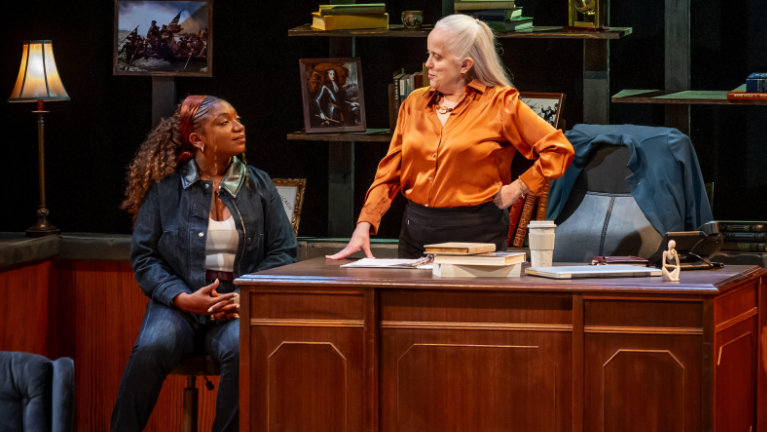
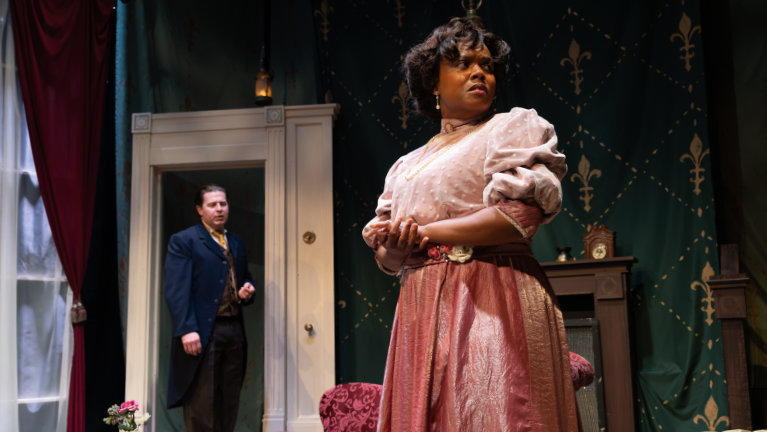
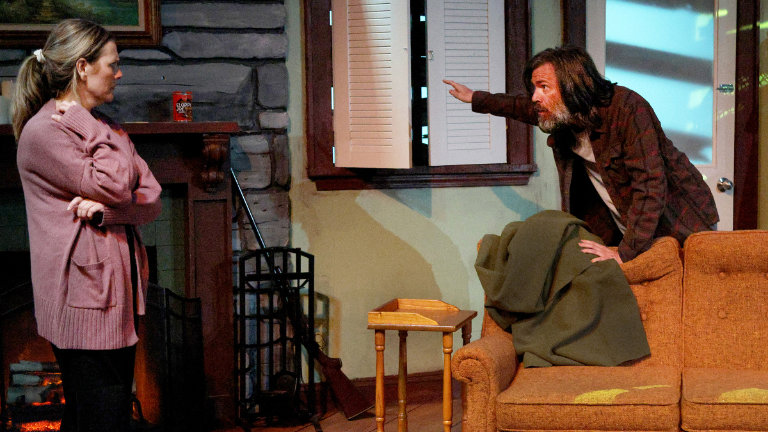
Michelle Hand and Nancy Bell are collaborating for the second time on Heidi Schreck’s “What the Constitution Means to Me.” The 2023 staging by Max & Louie Productions was excellent. The current staging in The Rep’s Steve Woolf Studio Series is extraordinary.
Schreck is both the narrator and a participant in the play. She paid her way through college, she tells us, from her winnings from extolling the Constitution in speech contests at American Legion halls across the country.
Later in life, Shreck began wondering what she loved so much about the Constitution in her youth. Because her mother discarded Shreck’s original speech, she imagines herself back in an American Legion contest to jog her memory.
Initially, Schreck slips easily into her younger self as she reconstructs her presentation. At that time, she was reluctant to include personal experiences, unlike a competitor who excelled at connecting with the Constitution personally.
As she continues, Shreck’s older understanding begins to emerge and her reticence falls away. She inserts a personal note about her great-great-grandmother, who came America came after her husband-to-be ordered her from a catalog. At 36, she died in a mental institution, where she was being treated for melancholia.
The adult Schreck keeps stepping outside the contest’s constraints to speak from the heart about the Constitution’s failure to protect her great-great-grandmother and others not in the group to which the Framers belonged: white men who owned property.
Male dominance in the writing of the Constitution is mirrored in the Seth Howard’s scenic design for the American Legion Hall where the contest takes place. Photographs of white legionnaires dominate set, which dwarfs the characters. The grouping of the pictures resembles a mushroom cloud. (See photo above.)
Costume designer Michele Friedman Siler dresses Schreck smartly for the debate in a deep pink blazer, a blue-and-white-striped blouse, and dark, tailored jeans. Her look without the blazer is strikingly less formal. Denisse Chavez’s lighting and Mary Robinson’s sound respond tellingly to changes in mood.
In 2023, I wrote, “Michelle Hand turns in a riveting portrayal of Schreck’s emotional journey.” She does so again, but she outshines her earlier portrayal by finding much more humor in the script. This gain is potentially problematic because the play contains harrowing descriptions of traumas suffered by people excluded from the Constitution’s protection.
The great strength of the Rep Studio staging the way it moves between hilarity and heartbreak. The miraculous transitions would not be possible without Bell’s superb direction, which imbues the production with physicality that guides audience response with unerring understanding and sensitivity.
Joel Moses is delightful as the serious-minded legionnaire moderating the debate, especially when the stuffy authority figure finds himself out of his depth as Schreck is hijacking the contest. Later, Schreck introduces Moses as a friend she recruited to play the moderator. Moses excels again in a highly personal monologue Schreck’s friend speaks as himself.
In the play’s final third, Hand abandons her character and tells the audience she will be herself for the rest of the play. It is a parliamentary debate between Hand and a teenager on the topic, “Should We Abolish the United States Constitution?” Amber Dantzler and Riley Carter Adams (another holdover from the Max & Louis staging) share the role of the teenager. I saw Carter in both productions. At The Rep, she improves upon the remarkable poise and self-assurance she displayed before.
At the Rep opening, Hand argued for keeping the Constitution; Adams argued for abolishing it. On another night, their roles could be reversed. The script includes two versions of the debate and says they should be used on alternate nights.
Moses once again moderates the debate. He points out that audience participation plays “a huge role in determining the outcome” of a parliamentary debate and urges the audience to “make some noise” to show strong agreement or disagreement with a debater.
Hand and Adams both excel in the debate, which sounds spontaneous rather than scripted. On opening night, arguments for abolishing the Constitution drew livelier responses from the audience, perhaps because disrupting the status quo is inherently a noisier process than maintaining it.
This debate’s outcome was not, however, determined by an applause meter. As always, one audience member was selected to choose the winner. I was pleased not only with the choice I saw but also with the quality of the ardent and adroit arguments on both sides of the question.
—Gerry Kowarsky
Photo by Courtney Guffey – Echos Photo & Film
Michelle Hand on the set of “What the Constitution Means to Me” at the Repertory Theatre of St. Louis