The Clayton Community Theatre’s current offering, Who Killed Aunt Caroline?, is firmly rooted in the time it premiered: the early 1940s. When the characters make telephone calls, they don’t have to dial a number on the landline. They can just pick up the handset and ask the operator to connect them to the other party.
A much more harmful practice from the past is key to the plot of Grant Richards’ mystery. Knowing that she will be fired from her job as a librarian if she marries, Agnes Endicott has turned down Dave Thompson’s proposal. Agnes puts her own happiness aside because her earnings are supporting her mother, Eleanor, and three school-age siblings: Ricky (a high-school senior), Beryl, and Cicely.
Times have been hard for Eleanor’s family since the death of her husband, Dr. Endicott. He came from a wealthy family, but he was disowned for marrying beneath his social class. His father left his entire estate to Dr. Endicott’s sister, Caroline, with one proviso. If she has no children, the estate will go to Dr. Endicott’s children.
Agnes’s self-denial and Ricky’s need for college money force Eleanor to do what she has resisted for many years—ask Aunt Caroline for money. A phone call to the imperious spinster impels her to come to Eleanor’s home to deliver a spiteful message. Caroline is about to execute a plan that will disinherit her nieces and nephews. Moments later, at the end of Act One, Caroline suddenly dies.
In the next two acts, Lt. Clayton looks into the suspicious death. Sticklers for procedure may bristle at the casualness with which the detective treats the witnesses and the possible crime scene. A harsher investigation would be distressing, however, in a play whose only unsympathetic character is the detestable victim. The other Endicotts are just as self-sacrificing as Agnes. The other witnesses, Miss MacLain and Miss Mabbitt, both deserve compassion for the abuse they have endured from Caroline.
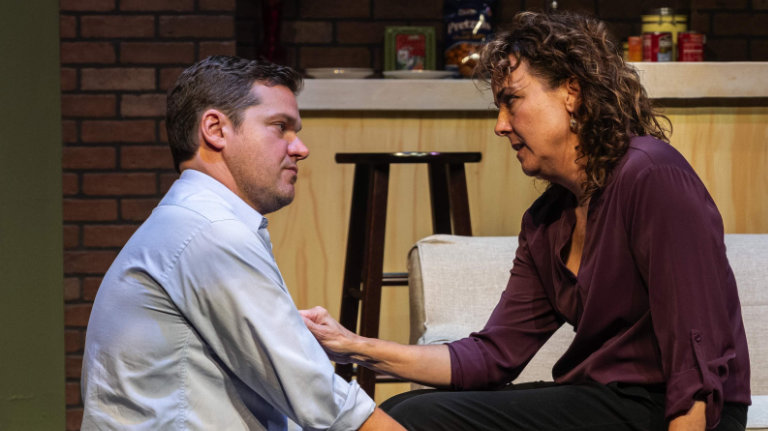
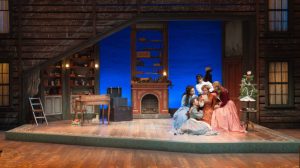
Director Ken Clark makes a case for the play in a program note and onstage. His direction take full advantage of the wide, richly detailed set of his own design. An attractive period atmosphere is established by Sophie Kluba’s props, Jean Heckmann’s costumes, Lori Renna’s hair and wig design, and Eric Wennlund’s lighting.
The fine cast provides vivid characterizations that are well gauged to the material and the period. Karen Wood as Eleanor and Vivian Partridge as Agnes project the genuine concern of women who understand the gravity of the family’s situation.
Tyler Webster (Ricky), Savannah Carmichael (Beryl), and Claire Hill (Cicely) give the younger Endicott children independent spirits and caring hearts. Angie Fink projects a daunting presence as the vindictive Caroline, while Mary Saputo conveys the anxiety of the ill-used Miss Mabbitt.
Makenzie Strickler is self-possessed and kindhearted as Miss MacLain. Sean Monarch is earnest and considerate at Lt. Clayton. Jack Connaghan makes Dave Thompson a worthy suitor for Agnes, and Dan Donovan’s Bobby Hinds is understandably confounded by Beryl. Eleanor’s piano student, Una, needs to be a handful, and she certainly is in Nora Lewandowski’s portrayal.
Who Killed Aunt Caroline? continues through March 16 at Washington University’s South Campus Theatre, 6501 Clayton Road. Showtimes are 7:30 p.m. Thursday through Saturday and 2 p.m. Sunday.
—Gerry Kowarsky
Photo by John Lamb
From the left, Cicely (Claire Hill), Miss MacLain (Makenzie Strickler), Agnes (Vivian Partridge), Dave (Jack Connaghan), Eleanor (Karen Wood), and Beryl (Savannah Carmichael) listen to Caroline (Angie Fink) in Who Killed Aunt Caroline?