The Repertory Theatre of St. Louis has opened its 2024–25 season with a winner. Under Melissa Rain Anderson’s direction, Dial ‘M’ For Murder is a gem.
The classic play by Frederick Knott is a thriller, not a mystery. The motive for murder is not mysterious. It is revealed in the first scene, when Margot Wendice tells her former lover, Max Halliday, about a blackmail attempt based on a love letter of his that was missing when she got her lost purse back. Margot thinks she is now off the hook, not realizing that her jealous husband, Tony, had the letter all along.
There are no suspects because the audience sees everything when Tony ropes an old acquaintance into a plot to murder Margot. When this meticulous plan goes awry, the audience watches as Tony improvises measures that put Margot in mortal jeopardy. The only unknown at the end is whether the authorities will discover the truth in time to save Margot.
Dial ‘M’ For Murder has remained in the repertory for seven decades because of its ingenious plotting and masterly control of tension. The Rep production shows off these qualities to their best advantage.
Jordan Coughtry’s Tony is a chameleon. He could not be more charming when pretending to be a loving husband or more chilling when he is up to no good. As Margot, Jenelle Chu is a completely convincing woman of the 1950s who questions her husband less than she should to preserve her marriage.
Jayson Heil precisely judges the solicitousness shown to Margot by her former lover, Max Halliday. He writes about crime for television, and his expertise enables him to say what Knott wants the audience to know about plotting crimes. Heil conveys this information without sounding like an authorial device.
Eric Dean White’s Inspector Hubbard is an exemplar of his profession. Ethan Stewart appears briefly as Thompson, another police officer. David Weynand brings a totally believable arc to Captain Lesgate’s recruitment into Tony’s murder plot.
Margery Spack and Peter Spack’s scenic design is another in the long line of Rep interiors that make me wish I lived there. The apartment’s entrance door is the center of attention at key points in the action. The Spacks make the door a focal point by putting a couple of wide stairs in front of it (see photo). The design on the risers is a menander, or Greek key, that make the stairs pop. There is small space between the floor and the bottom of the door. This gap—not specified in the text I consulted—is a wonderful touch because it lets the audience see the bottoms of shoes when someone approaches the door.
To fill the Rep’s stage, the set needs to be wider than the Wendices’ apartment would be in real life. Anderson’s direction uses the extra space so skillfully that it is never a problem.
The staging fits beautifully into its mid-20th century setting thanks to Ruby Kemph’s costumes, Amanda Werre’s sound, and Dennis Bensie’s wigs. Minjoo Kim’s lighting lets the audience see crucial moments that take place in the dark without disrupting the dramatic illusion. There are important contributions by fight director Paul Steger, dialect coach Joanna Battles, and intimacy directors Rachel Tibbetts and Will Bonfiglio.
Some Rep fans may recall that Anderson directed The Rep’s production of The Play That Goes Wrong, the last show of Steve Woolf’s tenure as the company’s Augustin Family Artistic Director. It can only be a good omen that Anderson returned to direct the first show of Kate Bergstrom’s tenure in the same position.
Dial ‘M’ For Murder continues through October 13 in Loretto-Hilton Center, 130 Edgar Road.
—Gerry Kowarsky
Photo by Jon Gitchoff
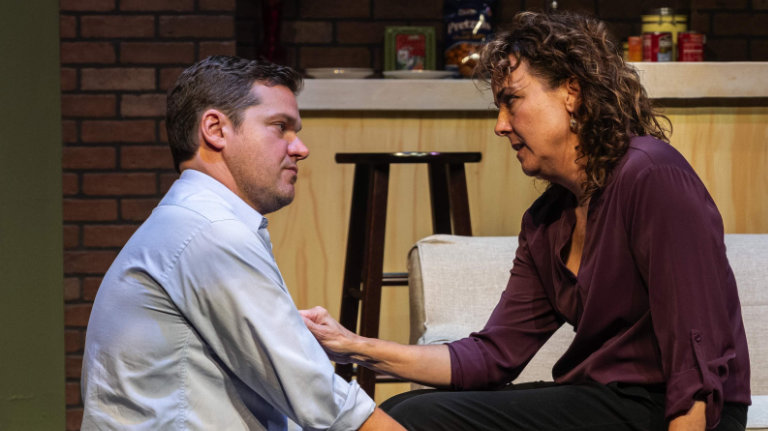
From the left, Jayson Heil as Max Halliday, Jordan Coughtry as Tony, and Jenelle Chu as Margot in Dial ‘M’ For Murder.