Thanks to the comic genius of Moliere, the brilliance of Richard Wilbur’s translation, and the talented and well-trained students at Webster University’s Sargent Conservatory of Theatre Arts, Webster’s current production of Moliere’s Les Femmes Savantes in Wilbur’s translation as The Learned Ladies amuses and delights with every comic moment.
Drawing upon his familiarity with the comic tradition back to the Greeks, Moliere elaborates a plot like many others about the conflicts between young lovers and their elders, with characters using types developed in the Italian commedia dell’arte. Moliere wrote many of his plays in rhymed couplets, whose rhythms and melodies give a dynamic impulse to the flow of the words. Wilbur translates into English rhymed couplets. Unfortunately, rhymed couplets are not the same in English as they are in French. Like the other romance languages, many French words end in vowels, giving the writer multiple choices of words with similar, rhyming last syllables. English words tend to end in consonants, and the poet’s choices are more limited and the rhyming, when it happens, is more obvious. Wilbur not only finds ways to make the rhyming less obvious, but when it is obvious, he takes advantage of that fact and delights you with the choice of the word that he has made. So while rhymed couplets can slow the dancing pace of the comedy in English, Wilbur’s rhymed couplets accelerate it and add to the pleasure of the language.
The young people the course of whose true love is not, thanks to their elders, running smooth are Henriette and Clitandre, portrayed as charmingly as they should be at Webster by Amara Webb and Matthew Cox. But Clitandre had previously courted Henriette’s sister Armande, and she, played by Chloe Berek, became a serious obstacle to their love. She had wanted a cold platonic relationship in every sense with Clitrandre, and Clitandre did not meet her standards as scholar, philosopher, and poet.
An even bigger obstacle is the mother of the two sisters, Philaminte, played with implacable determination by Remi Mark.. She is the leader of the little school of learned ladies, made up of Armande and her foolish aunt Belise, a comic turn by Maya Love. Philaminte has determined that Henriette shall marry the mediocre poet and supposedly learned man, the foppish Trissotin, who regularly regales the adoring learned ladies with his poems and essays. Magnus Kroken nails him precisely with every movement and word. Benjamin Speed as Trisssotin’s friend and rival Vadius visits the gathering and matches him in word and deed. Gillian Guthrie is the attentive maid who is fired by her mistress Philaminte for using bad grammar, which is worse than theft, according to the learned ladies. Her fellow servant LePines works with military precision in Anthony Communale’s performance. Luka Shorack plays a confused notary who is employed to record the marriage but can’t figure out which of the two men is the groom. And Aria Maholchic’s Julien swells the crowd.
Director Rebekah Scallet guided the cast to a proper representation of the manners of the time without losing the reality of the characters. She and Scenic Designer Fallon Podrazik made intelligent use of both a small stage in the Woolf Studio Theatre and much of the usual audience space in front of it. Dorothy Johnston’s costumes matched the period style of the show’s manners, as did the wigs and makeup of Bekah Toone. Greyson Norris’s lights fully illuminated the spreading space, and Katelyn Gillette’s sound design enriched the environment. Grant Vock was technical director, Natalie Scheers the props head, Camryn Dunivin the dramaturg, and Zoe Knutsen kept a keen eye on everything as stage manager.
I had a very good time at this splendid production of Moliere’s The Learned Ladies at Webster’s Sargent Conservatory of Theatre Arts.
—Bob Wilcox
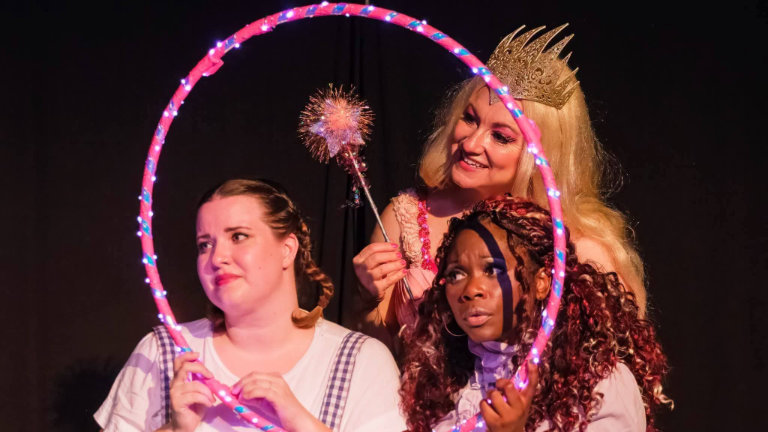
Photo by Phillip Hamer, featuring Matthew Cox as Clitandre and Maya Love as Belise.