For the sixth time annually, SATE Ensemble Theatre celebrated Aphra Behn, the first woman in the English-speaking world to earn her living as a writer. Appropriately for their recent Aphra Behn Festival, SATE presented three new plays by contemporary women writers, directed by women, with casts almost, but not quite, entirely of women. Performed in a large room on the fourth floor of the Centene Center for the Arts, the production called on the imaginations of the audience to compensate for the limited staging facilities of the space. But that is always the case in a theatre.
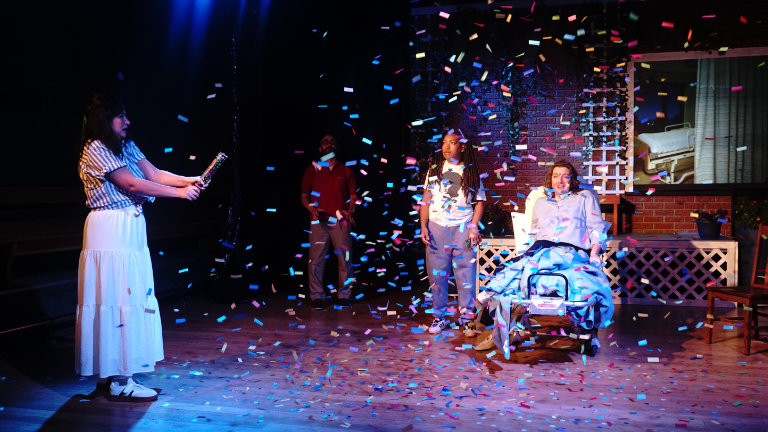
Michelle Zielinski set her play “Repurposed” in a gallery with modern art hanging on the walls and something like a phone booth – a tardis, perhaps? – as the centerpiece of the display. Jordan, the gallery attendant, tells Debbie, a sad young woman who wanders into the room, that the large box is called a “Party-in-a-Box.” When Debbie, avoiding interaction with Jordan, takes shelter in the box and pushes its start button, the enclosure is flooded with cheerful music and bright lights. When Esme, a frequent visitor to the gallery and an ebullient opposite to Debbie, arrives to visit with Jordan, she joins Debbie in the box. Eventually so does Jordan. The party box cheers up Debbie, she becomes friends with the other two, and they agree to help Debbie with a project at her job. Art and the party brighten the world for all three.
It’s a simple tale, nicely spun by playwright Zielinski. Director Elizabeth Van Pelt and set designers Allie Meadows, Emma Adams, and Sara Schaible find ways to meet the technical demands of the script. Taylor Kelly as Jordan, Nicki Huber as Debbie, and Ciera Thomas as Esme bring it to enjoyable life.
In Hazel McIntire’s “Go Before I Do,” a father and daughter meet in a bar in the small town where she grew up and he still resides, living alone after the death of his wife a year ago. McIntire’s dialogue flows smoothly as they reconnect and readjust their relationship with a discussion that sometimes digs deep into issues of who they are and where they are and what they are now to each other. McIntire breaks the scene on occasion so that each character, including the quick-witted bartender, can share with the audience private thoughts. I liked the way this worked in McIntire’s writing, in the work of director LaWanda Jackson, and in the playing of Greta Johnson as the daughter, Eric Satterfield as the father, and Jess McCawley as the bartender.
Playwright Lize Lewy set “The Super Fun Time Party Palace” at a six-year-old’s birthday party in an establishment of the same name. It’s sort of like a smaller Chuck-E-Cheese with elements from the City Museum. The birthday boy, Jacob, is climbing ladders and sliding down tubes. His parents, Jessie and Frankie, are waiting for the invited children and parents, none of whom has arrived. Frankie drills Jessie about the invitations, which Jessie was to have given to Jacob’s teacher to distribute to the class, and Jessie admits she gave them to the school secretary to give to the teacher. This leads to an explosive argument, which is interrupted by the appearance of Mr. Super Fun Time, a 17-year-old dressed in full but messy clown regalia and ready to entertain the non-existent birthday party. More explosive anger from Frankie, this time directed at Mr. Super Fun Time, because clowns frighten birthday boy Jacob and the parents had given strict instructions that there were to be no clowns at the party. The play ends with Frankie apologizing to Mr. Super Fun Time, and a disappointingly small resolution of the party problem. But the lively argument has held our attention. Rae Davis directed, with Ashley Bauman as Frankie, Julie Birnstein as Jessie, and Jack Elias as Mr. Super Fun Time.
Emma Glose was the festival stage manager. Grace Sellers designed the lighting, Liz Henning the costumes. and Ellie Schwetye the sound. Bess Moynihan was the set and prop design mentor, with the set for “Go Before I Do” designed by Sarah O’Bannon, Ashley Henke, and Grace Sellers; and for “The Super Fun Time Party Palace” by Adrian Smith and Grace Allagier. Designers, crews, directors, and casts all gave the playwrights thoughtful, caring, and I hope useful productions of their work.
—Bob Wilcox
Photo by Joey Rumpell